Thursday, August 25, 2011

Energy - Oil - Economy

Energy - Oil - Economy

It's incredible how short-sighted people are today. Oil prices decline for a few weeks and OPEC starts talking about a production cut, Chevron puts tar sand projects expansion on hold; and people start driving their SUVs again.

Folks, it's TEMPORARY. First, the oil tycoons want to keep Republicans in office. They give 11 times as much in campaign contributions to Republicans as they do their opponents because they like the status quo. They also know an election is coming up in just a few days and that high gasoline prices will encourage people to vote Republicans out of office, particularly if they've lost a job or a son in Iraq.

About this Hubbert curve crap; the theory being that the peak happens when half the oil is pumped out; that's just crap. There is a lot of oil in the ground, much more than has been pumped out. The problem is that the light sweet crude (requiring minimal refining) close to the surface under pressure (so you don't have to expend energy to pump or otherwise force it out) in giant pools (so one can get a lot of return on discovery investments) is gone.

What remains near the surface is heavy sour crude. Heavy crude is crude with a heavy mix of long chain hydrocarbons which has a very high viscosity sometimes requiring heat or solvents to get it to flow. Sour crude is crude with a high sulfur content requiring additional sulfur removal steps in the refinery process. Heavy crude also requires cracking and reforming to convert long-chain hydrocarbons to shorter more commercially valuable hydrocarbons. This takes additional energy and in extreme cases you can end up using the energy equivalent of five barrels of oil to produce one barrel of refined product.

Manufacturing the necessary drilling rigs to drill deep takes time, upgrading our refineries takes time. Even with the necessary upgrades it still costs more to produce and refine this oil than it did the light sweet crude near the surface that existed in the past. We really must start thinking of energy in terms of sources other than fossil fuels.

Our flavor of capitalism which utilizes money created by a private banking consortium which is loaned to our economy at interest, requires constant economic expansion to pay that interest. Constant economic expansion requires a constant expansion of energy supply, which, if we continue to rely on oil, can't continue indefinitely at the required rate. The growing economies of India and China exacerbate this problem by placing additional demand on limited oil supplies.

Until we adequately address our energy needs, we are going to see extreme instability in the economy where the economy grows until it runs into an energy wall, energy prices rise precipitously, our economy shrinks rapidly, the demand decreases, and then prices fall, and the cycle repeats itself. But as India and China continue to grow economically, and as inexpensive oil supplies continue to shrink, with each cycle we'll see less economic growth, higher energy prices, and a deeper depression following the rise in prices.

The best time to put alternatives in place is now; as time goes on we will have less and less energy and capital available to make the necessary infrastructure changes.

Now is the time to modernize our electrical grid converting all long distance lines longer than 300km from AC to DC transmission. This step alone save the energy equivalent of all the oil we import. At night we can not throttle down electricity production as much as demand decreases. If we used all of this surplus electricity to recharge plug-in hybrids and used that for our daily commute; we could eliminate again the energy equivalent of all the oil we import. Between these two things we could eliminate more than the energy equivalent of all of the oil we consume.

There is more that we can do, wind power is less expensive than even coal fired power stations. The argument is that we can't use more than about 20% wind power on the grid and that we must back any added wind capacity with an equivalent amount of base power generation. This is simply untrue; if we have a modernized grid capable of sending energy anywhere in the country, geographical diversity will allow us to depend upon about 30% of the installed wind capacity. That is, the wind is always blowing somewhere, and the minimum amount generated is about 30% of the capacity if you have reasonable geographical diversity.

There are ways we can use the excess to better effect when we are making more electricity than we need, we can make aluminum, we can electrolyze water into hydrogen and oxygen, we can store energy in large Redox battery systems which use oxides of vanadium as liquid electrodes, we can pump water up hill and run it through turbines to drive generators later.

If we were to go to a real-time metering systems in which the cost of energy varied with supply and demand, people and industries would shift their consumption habits to better match availability. People would do things like shift their laundry to times when energy costs are lower, install larger water tanks and heat water during off-peak periods, construct homes with larger thermal mass and other passive devices that will allow them to utilize less energy and time their usage to lower usage periods.

Instead of building a super highway between Mexico and Canada up the middle of the United States, we should be expanding and electrifying our railroads. We need to have a way to continue moving food and goods across our country when the oil runs out. If we wait too long to put this infrastructure in place; a lot of people are going to starve to death.

There are people who say that it's not possible to replace fossil fuels with renewables, that they aren't scalable enough. That is just hogwash. I've looked at this problem and we have ample renewable resources requiring no new technological breakthroughs. We could power this country off of geo-thermal, solar, or wind alone many times over, however, none of these can be ramped up instantly, neither can our automobile, train, and aircraft fleet be replaced instantly, so we really must do everything we can.

We should start developing our geo-thermal resources rapidly, particularly I think we could kill two birds with one stone and over time decrease volcanic hazards in some areas like Near Mt. Rainier or Yellowstone. Geo-thermal has the advantage of being "baseload" power, that is it is available 24x7 and not just when the wind blows or the sun shines.

We should build actinide burning fast-flux reactors and place them inside the hollowed out Yucca mountain repository; along with intergral pyrolytic reprocessing facilities so that we can get rid fo the long term radioactive waste instead of merely storing it, and derive huge amounts of energy in the process, approximately 100 times as much as was released in the initial one pass through a boiling water reactor.

Low grade heat from the fission products that remain could be used for everything from industrial source heat to home heating. Since the Yucca Mountain repository was designed for the long-term storage of waste; in the event of an accident in one of these reactors, the radioactive contamination would be contained as well.

We can have the largest depression this country has ever seen, with no recovery and the bulk of our population starving, or we can have a robust economy, a clean environment, and a comfortable sustainable future. It is our choice, but we are rapidly approaching the point where we will no longer have the necessary resources to build new infrastructure and then the choice will be taken from us. We can not allow our oil company owned politicians to steal our future from us.

U.S. and allies to tap into oil reserves

U.S. and allies to tap into oil reserves
The White House exercises one of its last remaining options to stimulate the struggling economy by adding to the supply of oil.
June 24, 2011|By Neela Banerjee and Walter Hamilton, Los Angeles TimesA surprise move to tap government oil reserves could slash painfully high gasoline prices this summer and give the U.S. economy a much-needed boost, but the rare action underscores the challenge posed by the weakening recovery.
The price of oil tumbled Thursday after the U.S. and other industrialized countries, citing the loss of oil from Libya, said they would release 60 million barrels of crude from emergency stockpiles and sell it on the energy markets over the next 30 days. Half of the oil is to come from the U.S. government's Strategic Petroleum Reserve on the Gulf Coast.
To some economists, the step is a Hail Mary pass showing that U.S. policymakers are just about out of moves to help the economy. On Wednesday the Federal Reserve cut its forecast of the country's 2011 economic output and confirmed the end of its controversial, 7-month-old program to boost growth with a $600-billion bond-buying spree.
With Congress unlikely to approve new government spending to stimulate the economy, the Obama administration is left with limited prescriptions, such as temporarily adding to the supply of oil.
"I view this as a kind of Band-Aid but the kind that's needed to avoid" another recession, said Frank Verrastro, director of the energy and national security program at the Center for Strategic and International Studies, a Washington think tank.
But Brian Wesbury, chief economist at First Trust Advisors in Wheaton, Ill., called tapping the reserve "an act of economic desperation."
"We've tried everything under the sun and yet unemployment is still high and the economy is in a soft patch," he said. "Now they're reaching for straws."
That soft patch has been blamed on a surge in oil prices early this year to as high as $113 a barrel, along with business disruptions created by the March earthquake and tsunami in Japan.
Thursday's news sent the price of crude sinking $4.39 to $91.02 a barrel in New York trading, its lowest closing price since Feb. 18.
On Wall Street, shares of airlines, retailers and other companies that would benefit from higher consumer spending finished the day higher on hopes that cheaper fuel will boost consumption by Americans who have been pinching pennies so they can afford to fill up their gas tanks.
But optimism for consumer spending was more than offset by another batch of weak economic reports, including a rise last week in unemployment claims. The Dow Jones industrial average finished at 12,050, down 59.67 points, after a wild trading session during which the index was down as much as 234 points.
Although the price of crude had already dropped in recent weeks, it remains well above its June 2010 level of about $75 a barrel, in part because the fighting in Libya has stripped about 1.5 million barrels of oil a day from global supplies.
The total amount of crude being released from reserves — 60 million barrels — amounts to less than a day's worth of worldwide oil production. Still it works out to 2 million barrels a day for the 30 days that the stockpiles are to be drained, more than making up for Libya's lost output.
As a result, some analysts said, crude could drop as low as $80 a barrel.
"The last thing propping up oil prices was the loss of … crude from Libya, and this release takes away that pressure too," said Phil Flynn, an analyst with PFGBest Research in Chicago.
It's unclear how long any decline would last. But even if oil merely stays below $95 a barrel, motorists could start seeing pump prices nationwide drop at least 50 cents a gallon from their current levels, said Jim Glassman, a senior economist at JPMorgan Chase & Co.
Nationwide, gasoline is selling at the pump for an average of $3.61 a gallon, down from $3.98 in early May, according to the AAA Fuel Gauge Report. A year ago, the average was $2.74 a gallon.
In California, the average price stands at $3.88 a gallon, down from $4.25 in May and $3.11 a year ago.
For gasoline prices to get back to where they were last summer, crude prices would need to drop to $70 to $80 a barrel, analysts say.
Any significant decline could juice economic growth in the second half of the year, adding to a rebound already predicted by many analysts who say the current slowdown is the result of temporary factors.
Until then, however, the Obama administration must fight the perception that the economy is swinging back and forth with no real gain, and that there's nothing on the horizon to improve the outlook.
"A slowdown can become self-reinforcing if business and consumer confidence falters, and that's what's happening right now," said Jane Caron, chief economic strategist at Dwight Asset Management in Burlington, Vt.
The U.S. last released oil from its strategic reserve in 2005 in the wake of Hurricane Katrina, which damaged much of the country's capacity to produce crude.
"We are taking this action in response to the ongoing loss of crude oil due to supply disruptions in Libya and other countries and their impact on the global economic recovery," U.S. Energy Secretary Steven Chu said. "As we move forward, we will continue to monitor the situation and stand ready to take additional steps if necessary."
In Washington, reaction to the decision to tap the oil reserve broke down along partisan lines. Democrats and their allies backed the decision. Republicans and their supporters uniformly decried it as a political gesture meant to shore up the president's flagging approval ratings.

Cambodia's coming oil economy

Thailand

Cambodia's coming oil economy

Analysis: What might oil drilling do to a poor country, its people, and its government?

EmailEmail
0diggsdigg
Cambodian women on the Thai-Cambodian border Oct. 16, 2008. Cambodia's wealth of natural resources is attracting foreign investors. (Adrees Latif/Reuters)
BANGKOK – Haunted by war, and wracked by poverty, Cambodia has had little opportunity to enjoy one its few blessings.
The nation of 14 million people, sandwiched between Thailand and Vietnam, is flush with natural resources. Veins of iron and gold run beneath its soil. Natural forests offer a wealth of timber. Most promising of all are Cambodia’s deposits of oil and gas, believed to snake offshore all the way through the kingdom’s lush interior.
As Cambodia’s leaders begin to parlay these natural blessings into wealth, selling off drilling rights to firms across the globe, American oil companies are taking notice.
So, too, are the watchdogs.
Foreign aid, in large part from U.S. tax dollars, accounts for half of Cambodia’s national budget. Much of this is aimed at the more than one-third of Cambodians living on roughly 50 cents per day.
While Cambodia’s ruling party could use the coming resource wealth to wean the country off foreign aid — and potentially lift millions out of poverty — leaders already appear to be hording this money for themselves, watchdogs say.
According to Global Witness — the U.K.-based non-profit that helped expose the West African “blood diamonds” trade — the coming oil wealth will likely just entrench Cambodia’s ruling cabal in corruption.
“In a couple of years, the elites will be so wealthy it will be hard to rewind the tape,” said Global Witness Director Gavin Hayman during a business trip in Bangkok. The non-profit recently published an investigative report on Cambodia’s growing oil wealth.
(This map, prepared by U.K. nonprofit Global Witness, reveals the offshore Cambodian territory U.S. energy firm Chevron plans to drill for petroleum. Source: Global Witness)

Response to recession as the oil economy fades

Response to recession as the oil economy fadesImmediate responsessummary    details of fading hydrocarbons   price spikes   timeline   the immediate future
recession in USA    recession overview  
medium term reponse to recession 
recession to depression


"Without massive mitigation more than a decade before the fact, the problem will be pervasive and will not be temporary. Previous energy transitions were gradual and evolutionary. Oil peaking will be abrupt and revolutionary."
from Hirsch, Bezdek and Wendlings report 'The Peaking of World Oil production: Impacts, Mitigation, & Risk Management', in a March 2005 report to the US Department of Energy.

"Abrupt". "Revolutionary".

The first response of governments in industrialised oil economies is panic.

The second response is to 'do something'; firstly to make petrol affordable, and secondly to cut oil use.

Governments might pay corporate welfare to oil companies to keep the price to the consumer artificially low. There are no free lunches. The money has to come from somewhere. It must come from the taxes paid by ordinary citizens. Such a practise is unsustainable - it causes a ballooning deficit. Governments could instead simply print money to pay corporate welfare. But the result is spiralling inflation, high interest rates, credit defaults on citizens house loans, bank failures from failed loans and few buyers of defaulters property

If the advisors are capable of logical analysis, they realise that their options are constrained by reality. The possible responses are useful at the margin. But only at the margin. Many 'immediately doable' things can make a difference, but their added effect is trivial relative to the scale of the problem. There are no new sources of cheap and concentrated energy to match oil. That is the unhappy truth.

No 'techno-fixes'. No new inventions. No solutions. While all energy conserving actions are useful - and inevitable - in the short term they are far too little, and it is now far too late to make a useful difference. The time to implement the larger responses will take many years and vast capital.

In addition, the western economies will all want the same sort of infrastructure - new dams, new electric trolley buses, electric trains, small cars, coal liquifying plants, LPG terminals, many more LPG transport vessels and storage structures and so on. Obviously, even if you can pay for it, you may have to go on a waiting list that stretches for years. Such infrastructure doesn't appear overnight.

Quickly achievable but trivially important steps - Governance responsibilty
Legislate immediately to prevent overseas banks bankrupting locally registered branches; legislate for government to have power to protect citizen interests in a failed bankRecession and inflation is inevitable. In the long term, perhaps there may be depression and deflation. Short term, jobs will disappear and people will find it hard to meet repayments on their mortgages and borrowing for consumption spending on new cars and overseas holidays. Prices will 'structurally inflate' to accomodate higher oil-input costs. Spending power will erode. This will  make it even harder to repay interst on domestic loans. Mortgages will be foreclosed. Houses will sell on a buyers market - but there will be few buyers. People will lose a large amount of equity in their houses - or even lose everything. Banks will have a greatly reduced profit. Thats the 'best case' scenario.

In the 'worst case' scenario, all the above will apply, but with a new twist. USA treasury has to print more junk bonds ('treasury bonds') to attract foreign capital, as it is in very deep debt. Other countries may do similar things, depending on the underlying rigor (non interference in market forces) of their monetary policy. To make an unattractive proposition attractive, it raises the promised interest on the bonds. The result is increased bank interest rates on their offers of loan money. The flow-on is a big hike in the interest rates on existing loans to small business and home owners. In a recession, many of these loans 'go bad'. Small business and domestic bankruptcies follow. The dollar falls rapidly. Panic ensues. People attempt to draw money from the bank. A 'run' on the banks ensues. As banks typically have less than 12% in 'real' money on hand at any given time (the rest is loaned out) banks can't immediately pay. Doors close.

In the shake-down, banks do two things - first, bankrupt branch offices in other countries by withdrawing all the funds in savings and investment accounts as return of capital on closure of the business. The bad debts - mostly to the offshore 'mother company' - remain. Bankruptcy is declared. Customers savings in those countries literally 'flit overseas' in a digital blink.

Second, banks ask for corporate welfare to reward them for all their bad decisions. This is by way of a government 'guarantee'. In reality, the government pays the banks bad loans for them. That is, the taxpayer - relatively poor citizens - are to pay their much needed money to the very rich. This may be seen as unfair.

Bottom line is, governments will need to act very early and very quickly - before there is even a sniff of a run on the banks - to prevent citizens saving in local branches from being sent abroad literally overnight. Once it has gone, it will be irretrievable.

In like manner, barring a national government-owned bank prudently run (not exposed to the US dollar, no dubious loans), any request for a 'bailout' by a bank defaulting on its obligation to pay its creditors (your savings) should be refused outright. The bank shouild be declared bankrupt, and the assets of the bank (including bad debts) should be taken by the government on behalf of the creditors; just as a bank takes the house of the citizen who defaults on the bank loan.

Don't  guarentee bank debt, but legislate to prevent savings accounts being used to pay bank debt and make savings account holders have first call on a banks assets
Typically, banks arrange to sell (either directly, or indirectly via complex 'swap' arrangements) interest paying bonds overseas which are 'self funding' - that is, the money paid for the bonds is on-lent on the domestic market for house loans, car loans, holidays, and consumption spending. The bank adds a profit margin to the interest charged to the domestic borrowers over what it has to pay the overseas bond holders. Clearly, as the banks have borrowed offshore, they must re-lend what they themselves have borrowed in order to get a profit margin on the debt they have taken on. If they can't, they make a loss.

The bonds run from 2 to perhaps 5 years or so, and then must be repaid. In a bubble of frenetic lending, the bond money is being sucked in the backdoor as fast as it is being re-lent out the front. This creates a 'wave' of bonds coming due for repayment all at once.

When the economy enters recession and the re-lending business for consumption business has evaporated, the banks are faced with overseas investors wanting their money in repeated 'bond maturity date' waves. If  a significant number of domestic mortgage loans and poorly secured business loans 'go bad', the banks cash-flow may not be enough to repay all bondholders as they come due. If allowed, they will presumably use customers savings to repay debt, even although this may not be enough to clear the debt due to low savings levels in many countries.

It is imperative to legislate very early to prevent any bank using the savings accounts of private citizens to repay debt. It is imperative to legislate very early to prevent any bank using any devise with similar effect.

The banks may attempt to turn their disasterous loan mangement into a bank profit. They may attempt to socialise their risks (debts) by appealing to the government to fund them 'to protect citizens savings'.

Any request for a 'bailout' by a bank defaulting on its obligation to pay its overseas creditors should be refused outright. The bank should be declared bankrupt, and the assets of the bank (including bad domestic home and business debts) should be allowed to be sold on behalf of the bond-holding creditors. There will likely be few takers in a recession. By legislating to prevent any but citizens owning domestic residences, any prospect of overseas speculators 'buying up' the citizens houses can be extinguished. The only possible buyer would then be the government. And it would then demand - and get - extremely favorably prices; cents in the dollar. The bond-holders may not get all their capital back. But that is always a commercial risk.

By making domestic savers the preferential creditors with first call on the banks assets, peoples savings are protected. As those employed continue to pay the receiver their (re-negotiated) mortgage, the repayments go to re-imbursing savers in full.

Regulate shipping industries and road transport so that cartels are broken

When oil is expensive, freighters are tempted to form cartels and 'price fix' their rates at a higher level than if they were subject to free-market competition. When spending power is down anyway, this anti-competitive behaviour adds unecessarily to domestic price inflation.

Stop all major highway projects
Luxury use of highways (holidays, visiting, and general 'tooling around') will fall away rapidly as the price of gas makes people think twice about driving. Save the money for public transport.

Remove all duties and taxes from all small engined vehicles, whether two, three, or four wheeled
The gas saved is unimportant - the rate of world consumption is so high that reducing automotive use won't make a meaningful difference. The importance of this measure is simply to make automotive travel as affordable aas possible for the ordinary working person. Smaller, lighter, vehicles use less gas, and therefore use up less of the average weekly paypacket.

Mandate safe and secure use of bicycles
Create and expand networks of car-excluded travel lanes for bicycle as marginal strips along roads, and as dedicated 'lanes' on footpaths. Change road rules to allow bicycles to make safe 'with traffic' turns at red lights.

Mandate that cities and towns provide widespread securable bicycle parking in the close proximity to offices and businesses.

Mandate that trains provide a combined bicycle with passenger carriage.

Remove all bureaucratic barriers to coastal and riverine shipping
Propelling heavy loads in barges and ships along canals and coastal waterways is a very fuel effective way of moving materials. The cost saving of using water transport helps to limit the structural inflation bedding into an economy based on expensive oil. In addition, an increase in coastal shipping and coastal docking facilities provides a source of jobs for members of the local community in a recessionary economy.

Break all cartels and monopoly ownership of scarce coastal docking
Docking will increasingly become a natural monopoly. While the numerically small 'greedies' in society would privatise any 'public good' for their personal further enrichment and make society pay as many of their private costs as they can, in a time of re-adjustment in society, the greatest public good comes if strategically important monopoly assets are taken back from private ownership.

Logs, for example, may be cheaper to transport in sea-borne rafts. But docking infrastructure is essential to allow yarding. Dockside rail tracking is essential to allow the logs to be carried internally. Public ownership of strategic docking and yarding space must be indisputable, non-negotiable.

Break all cartels and monopoly ownership of strategically important railway infrastructure
Rail transport will increasingly become a natural monopoly. Rail was made marginally economic by the advent of cheap oil. The situation has now changed. Permanently. Rail is around 5 to 10 times more energy efficient than road transport. Rail will be cheaper than road transport for many, if not most, items. It can also be a useful employer of labour, helping to keep men occupied in what could be a period of high unemployment.

Rail needs to be forcibly integrated with water-based transport. Dockside roads that once shared with rail have in many cases had the rails removed. They will now need to be put back, and take priority over automotive transport when using the shared road.

While the numerically small 'greedies' in society would privatise any 'public good' for their personal further enrichment and make society pay as many of their private costs as they can, in a time of re-adjustment in society, the greatest public good comes if strategically important monopoly assets, or the strategically important parts of a national rail network - at least - are taken back from private ownership.

Revise tax law to encourage a local sole trader economy
Small business, contrary to the perception of many - including so-called economic 'experts' - is the major employer of people in an economy and is fundementally much more important to the health and happiness of the majority of people than big business.

The price of fuel helps shape where people shop. When fuel prices are structurally high they will tend to shop closer to home. When large complexes with cheaper prices are physically distant, the possible saving available may be cancelled out by the cost of using more petrol to get there and return home than if shopping locally. Local markets may help keep local prices in check. For example, the profit centre of most supermarkets is fruit and vegetables, where profit margins may be around 20% (versus around 4% for most other goods in store), but local markets of seasonal fruit and vegetables may help keep prices in check. Where supermarkets are constrained to retain their existing pricing, local markets give an alternative source of lower cost fruit and vegetables.

Small time and first time entrepreneurs might be given help with the mechanics of running a business, and be forgiven taxes until they are worth taxing (if ever).

Shift public funds out of investments in recession-vunerable industries to infrastructure industries
Pension funds and some more prudent government treasuries have funds invested to provide for an aging populations health and welfare needs. Where these are independantly managed, they are likely to be very exposed to a severly weakened USA dollar and to fading consumption industries whose sun will rapidly set in a recession. Most private pension funds assets are 60% - 80% in stocks. Most private stock plans are predicated on unrealistic rates of return - 8% or 9% - continuing far into the future. This is utter fantasy. Even those invested in property trusts have a much lower income in a recession (around 2.5%).

Vast amounts of pension contributory and taxpayer funds may be at risk.

Funds could usefully be shifted to provide capital for the monopoly infrastructure needed to be 'least battered' in the coming crisis. Docks, strategic ships and barges, gas terminals, gasification plants, new hydro projects, repairing existing gas lines and rail lines, laying new gas lines and rail lines, repairing existing electricity line, building strategic new lines, building new rail stock, repairing rail stock, capitalising small business importing and modifying small engine cars to gas, laying new rail lines down quay-side streets, and so on.

The risk is that the long-term benefits of infrastructural chnage - measured not in profit but in lessened public distress - will be captured by rich individuals, in line with their socially contemptuous 'my-personal-enrichment-is-more-important-than-the-needs-of-the-entire-population-I-live-amongst' view that all public good 'should' be stripped from the vast majority of ordinary people and be directly or circuitously transferred to the already hugely overstuffed bank accounts of the tiny minority of society they represent.

And just this will happen if naiive public officials are gulled by the endless and highly polished false assertions of the 'economic advisors' employed by these closet monopolists. Stripped of the jargon, the false mantra is that only these few private individuals know anything about running efficient and uncorruptable enterprises. Among the countless rebuttals to this garbage propoganda, one stands out.

Enron.

Countries with deficient Retirement, Medical, and Social Welfare Funds must cut Military and Medical spending to extremely low levels as soon as possible
Other countries (chief amongst these the USA - of the US$7.4 trillion Federal debt in 2004, US$3.1 was owed to government Trust Funds such as the Social Security Trust Fund, Federal Employee Retirement Fund, Federal Hospital Trust Fund, etc) have already taken most of the surplus saving in the Government Trust Funds in order to help fund deficit shortfalls. They have replaced actual money with treasury bonds of dubious worth. Nothing can now be done to restore the broken trust. The relatively small excess paid in from employee taxes over that required to pay retired persons pensions has not been accumulated for the future. They are essentially 'unfunded', and live off taxs paid from year to year. There is no provision for the bulge of 'baby boomers' reaching retirement age. There is no provision for a dramatic cut in payroll tax paid as the number in work drops dramatically. Truly massive cuts to the most expensive government services, and increased taxes for those working, are the only options available.

Ban ploughing
Ploughing requires a series of tractor cultivations of the same patch of dirt - one pass for ploughing, back over it again for rotary hoeing, back over it again for harrowing, and in some cases a further trip across the same dirt to roll the field. Using 'reduced tillage' and 'no tillage' techniques, the field can be sprayed with herbicide once, and then 'direct drilled' with seed in a second pass. This technique is used on 48 million hectares of cropping land of the West Eurasian Economic Union countries. It has resulted in an estimated saving of 6.4 million tonnes of oil a year - the equivalent of the entire annual oil use of a small country such as New Zealand.

Of course, if the arable industry already uses low tillage techniques, there is little room to move.

Book review: The Long Emergency by James Howard Kunstler reveals a bleak future after peak oil

 Book review: The Long Emergency by James Howard Kunstler reveals a bleak future after peak oil
Friday, July 20, 2007
by Mike Adams, the Health Ranger
Editor of NaturalNews.com (See all articles...) 


Share   


"The Long Emergency," by James Howard Kunstler, is a fascinating and timely book that explores the ramifications of the dwindling supply of fossil fuels on our planet. The book begins with a discussion of the concept of "peak oil" -- a term that indicates we've nearly reached the peak production of fossil fuels for energy. After the peak oil point is reached, oil production will decline and the price of oil will naturally rise.
Kunstler points out that not only has oil likely reached a peak in terms of global production that may have occurred in the last two or three years, but at the same time the demand for oil is sharply rising around the world, especially as nations like China demonstrate an increasing appetite for energy consumption. As a result, countries that once seemed to have an unlimited supply of oil, like the United States, are now going to have to compete with nations like China for those limited energy supplies.
He then goes on to discuss the interdependency of our modern-day society on cheap oil. This cheap energy, as Kunstler explains, is responsible for many of the things we take for granted in modern life, including the ability to sustain the population of the world at its current levels. The population explosion over the last century, Kunstler explains, has been fueled by cheap oil.
Oil acts like a helping hand to every individual; it leverages and magnifies the intentions and efforts of societies, allowing, for example, only two percent of the population to engage in farming activities in order to feed 100 percent of the population; whereas a hundred years go, around half of the population engaged in farming. We are able to build our cities, grow our population and businesses, and erect a large international travel infrastructure thanks to cost-effective energy that, according to Kunstler, is likely to start dwindling.
As a result, many things in society we take for granted today may no longer be feasible after the era of cheap oil. For example, simply growing corn requires a tremendous amount of fossil fuel. How do you grow corn, or even transport it, when the era of cheap oil is over? Kunstler believes that the future success of our society will require becoming more localized and community minded. He also points out that big cities in the United States today -- in contrast to their European counterparts -- are designed around the assumption that cheap oil will always be available. Most Americans commute long distances between work, grocery stores, schools and home, and these long commutes are only possible because of cheap oil.

Are we doomed when oil runs out?
I believe that Kunstler is correct in his assessment of the structure of modern society and its dependence on oil. Unless we can cultivate a new source of cost-efficient energy, we are no doubt doomed to roll the clock back to much a simpler time. He convincingly explores the rather startling ramifications of the end of cheap fuel. However, there's one area where I hope the author is incorrect: the search for alternative energy sources. Kunstler refutes the idea that there are any viable replacements for oil, but I believe we may yet find hope in the search for alternative, renewable energy sources.
Nuclear, solar, wind, cold fusion, gas hydrates and many other areas of alternative energy are discussed in the book, and each one is shown to be inadequate in replacing the loss of fossil fuels that seems inevitable. If Kunstler is correct, we are in for a rough ride that would no doubt include a rather sharp population correction. Without inexpensive fuel resources, the world simply cannot support our current population. But I personally believe there is reason to be optimistic about possible alternatives, including large-scale solar, solar / Stirling engine hybrid generators, Concentrated Solar Power farms (CSP), and even possible breakthroughs in alternative science that could lead to new energy sources that are nothing less than miraculous (zero point energy harvesters, for example).
Now, it may be naive to have faith in such developments until they can actually be proven viable, but something tells me that human ingenuity will find a way to overcome the loss of cheap oil, even if it involves doing the exact things described by Kunstler -- riding our bicycles more and greatly reducing our consumption of energy in both residential and commercial environments. To succeed in a post-oil era, we may need to radically alter the zoning of our cities so we can live closer to the businesses we visit on a day-to-day basis, and give up many of the luxuries of modern American life including RVing across the country at six miles per gallon.
Regardless of whether Kunstler is correct about the bad news on dwindling energy supplies, "The Long Emergency" is worth reading. The thoughtful presentation shows that Kunstler has a wide-ranging, well-educated view of what makes society tick. He understands that in this era of mass specialization and dependence, it takes only one wrench in the machine to throw the whole system out of whack, and the end of cheap energy could be that wrench.
If you are not familiar with the concept of extreme interdependence in our global community today, then you may find this book to be one of the scariest you'll ever read. If you think that water magically appears out of your faucets, or food magically appears in the grocery store, or that gasoline just flows out of gas station pumps sort of like water out of a spring in the ground, then this book is going to give you quite a shock. It's going to show you a different side of society, where the interdependence that we take for granted might not remain viable. Whether you believe in the author's conclusions or not, this book makes for excellent reading about the future we may all face if we don't get serious about two things:
1) Reducing our energy consumption through conservation and efficiency measures. (This is part of the reason why I launched http://www.ecoleds.com/ and the effort to promote energy-efficient LED lighting products.)
2) Developing renewable energy sources to replace fossil fuels. The most promising are wind, CSP and solar power.
So grab a bicycle. Turn in your old gas banger for a hybrid vehicle or, better yet, a plug-in electric when they become available. And stop driving five miles to the video store to return a DVD that weighs 4 ounces. Go solar! 

Learn more: http://www.naturalnews.com/

Ghana’s Emerging Oil Economy: - the Good, the Bad and the Ugly

Ghana’s Emerging Oil Economy: - the Good, the Bad and the Ugly
. , 26/04/2011

Author: Nana Adjoa Hackman

Enter December 15, 2010, commercial production of oil from Ghana’s Jubilee fields commences. The much awaited event is heralded by Ghanaians with much joy and hope…hope for an improvement in the general welfare and living standards of the average Ghanaian.

Current production levels from the oil field are estimated to be approximately 55,000 barrels per day, a figure which is expected to more than double to 120,000 barrels per day within six months after the commencement of production.

Having joined the league of oil producing nations (although on a very modest scale), Ghana is expected to earn an additional four hundred million dollars (US$4,000,000.00) in this first year of production. This would complement income from the nation’s traditional income earners, cocoa, gold, timber, diamond, bauxite, manganese, aluminum, etc. The government projects that the additional income would move the country’s economic growth rate from 5% in 2010 to 12% this year, 2011.

That said and done, the good thing in this writer’s opinion is that Ghana is starting off with a relatively diversified economy. Although not much can be said about Ghana’s manufacturing sector, agriculture accounts for 35% of GDP, the services sector accounting for 50%. There is also a richly diverse natural resource base consisting of gold, diamond, manganese, bauxite etc that fetch the country a substantial amount of foreign exchange.  Also in recent times, there has been an impressive growth in earnings from the non-traditional export sector which covers citrus, pineapples, garments, textiles, handicrafts etc. compared to these other income earners, the current revenue from oil is approximately 6% of the total annual revenue for Ghana.

This is in direct contrast to the situation in other oil producing African countries which are almost totally dependent on oil revenue. Nigeria for instance earns 92% of its revenue from oil, while Angola’s oil revenue forms almost 100% of its total revenue. The finite nature of the oil resource, coupled with frequent shocks associated with the fluctuating world market price for oil makes this a very risky position for any country to be in.

Ghana must be minded that at the time of Nigeria’s first oil discovery in 1960, the contribution of agriculture to its economy was 63%. Due to neglect however, the sector’s contribution to Nigeria’s annual revenue is now in single digits. Thought the country has reserves of bitumen, tin, bauxite, iron ore and gold which are potential income earners, Nigeria has not invested into developing these areas. As a result of neglect and records of massive corruption, investment outside the petroleum industry in Nigeria is minimal.

In the case of Angola, the country is recorded as having one of the fastest growing economies in the world. This not withstanding, due to the almost total dependence of the economy on oil, the country risks the negative consequences of a slump in oil prices. There is also evidence of strategic efforts to diversify the country’s economy by developing other sectors. This homogeneous economy, though growing at a fast rate, is likely to collapse when faced with declining oil resources.

As the fun fair surrounding our own discovery and production of oil continues, we must as a matter of urgency prioritize efforts to deepen our economic diversification. It is only in doing so that we can achieve sustainable economic growth in the true sense. Government must see the need to invest in infrastructure that would aid the growth of the agric sector. Infrastructure such as irrigation systems, and factories to process some of our major farm products for export, giving added value to what we already have.

A good starting point would be to develop a petro-chemical industry leveraged on our oil and natural gas resources. A petro-chemical industry is one that produces chemicals using oil and natural gas as raw materials. A petrochemical plant may produce chemicals in their basic or raw form such as ethylene, propylene, benzene, toluene and xylene isomers. These primary products can be used to feed a secondary petrochemical industry which would then convert them into industrial materials or products for use by other industries or may process them into consumer products.

A petrochemical industry opens a window into the manufacturing of a wide variety of products which are useful in our every day lives. These include plastic products, synthetic textiles, detergents, pharmaceuticals, car tyres, inks and dyes, fertilizers, paints, engine coolants and lubricants etc.

The petrochemical industry has been the backbone for the growth of many of the world’s strongest economies today. Notable among these is the United States of America.  Today, the world’s largest petrochemical industries are found in the USA and Western Europe. Other countries like Canada, Saudi Arabia and India also have strong petrochemical industries. A petrochemical plant in Saudi Arabia


Not only would such an industry create jobs, it would also ensure added value to our oil and natural gas resources, both for domestic use and for export. To say the least, it would create the platform for the much needed growth of our industrial and manufacturing sector and put our country on track for a transformation from the class of developing or third world countries into the category of developed or industrialized nations.

Libya: impact on oil, economy?


Libya: impact on oil, economy?

Our experts believe the global economic recovery is not yet in jeopardy.

The North African countries that have undergone the greatest political unrest so far—Libya, Egypt, and Tunisia—collectively account for only a miniscule slice of the global capital markets and economy. However, ongoing developments in the region can affect the global financial markets in a variety of ways, particularly through their influence on crude oil prices and the geopolitical risk premium for financial assets.

Oil prices and supply/demand imbalances

While turmoil in Tunisia and Egypt put upward pressure on global crude oil prices, the negligible petroleum production from those countries meant there was little impact on the global supply/demand balance for crude oil. However, Libya accounts for roughly 2% of global oil production and 3% of global oil exports.1 With reports that significant amounts of Libya’s production have gone off-line, there is likely some fundamental impact from the region’s unrest on the global economy.
Losing Libya’s production from the global crude oil markets, however, is not likely to be a traumatic event because the world is reasonably well supplied with oil and has some supply cushions that could help prevent near-term disruptions of this magnitude. Crude oil inventories held by the 34 countries that are members of the Organization for Economic Co-operation and Development (OECD) are at above average levels, with nearly 58 days of supply on hand versus an average of 53 days from 2005 to 2008.2 Spare production capacity, primarily in Saudi Arabia, is estimated to be more than twice the size of total Libyan production, and Saudi Arabia has already brought a portion of this online. In addition, several countries, including the United States, maintain strategic petroleum reserves that could be utilized as well.
Global Crude oil production and exports From a fundamental supply/demand standpoint, the outlook for higher crude oil prices in 2011 was already expected, with prices having moved up 12% in the fourth quarter of 2010 largely because of the strengthening U.S. and global economies.3 However, the majority of the increase in crude oil prices in recent weeks has been due to an increased “risk premium” for the commodity, which reflects the possibility of political unrest spreading to additional and particularly larger crude oil producers in the region.
Since Egypt’s “Day of Rage” on Jan. 25, 2011, the per-barrel price of U.S. crude oil has risen to almost $98, from $85, while European crude oil prices spiked above $110, from $96.4 If any additional producers from the Organization of the Petroleum Exporting Countries (OPEC), such as Saudi Arabia and Iran—which together account for roughly 20% of global exports—were to experience supply disruptions, it could cause a far greater spike in crude oil prices (see the table below.) Read Viewpoints: Rising oil prices and energy stocks for further commentary on the energy sector from John Dowd, portfolio manager of Select Energy Portfolio (FSNEX) and Select Natural Resources Portfolio (FNRAX) .

Perspective on rising geopolitical risk and the threat to riskier financial assets

Stock and bond markets in the Middle East and North Africa are small by global standards, but the potential for the spread of political instability can have an impact on the risk premium for financial assets around the world. So far, the biggest impact on performance has been to securities in countries most directly affected, with Egypt’s stock market down about 20% in 2011 before it was suspended in late January, and the prices of its dollar-denominated government bonds declining about 10%.5 Emerging-market assets as a category have gotten off to a choppy start in 2011, though much of this can also be attributed to inflation pressures and other investor concerns that were apparent before the recent political turmoil. The longer the political upheaval lasts and the farther it spreads, the more potential it has to increase risk aversion and act as a headwind for emerging-market stocks and other assets. So far, the detectable damage has not been extensive.
More broadly, the political and economic uncertainty has the potential to act as a headwind for riskier assets. The week ending February 25 featured the largest negative returns of any calendar week for the U.S. stock market in 2011. However, the 1.7% loss to the S&P 500® Index was a relatively minor pullback in the context of the 16.6% rise during the past five months. While safe haven assets such as Treasury bonds and gold rose, whether risk aversion continues to increase will likely depend significantly on whether the events in the Middle East pick up steam or begin to stabilize.6

Outlook on contagion, crude oil prices, and the global economic recovery

The potential for political upheaval to spread to other crude oil-producing nations is inherently unpredictable and unquantifiable. The countries that have experienced unrest so far have shared a few common traits, some of which are held in common with other oil-producing countries in the Middle East. These include high levels of unemployment and poverty, a population with a high percentage of young adults, and leaders who have exercised power for decades with regimes widely recognized for corruption and repression. However, even the largely non-violent spontaneous demonstrations in Egypt look very different from the armed conflict in Libya. So while many key oil-producing countries, from Algeria to Iran to Saudi Arabia, have something in common with these economic and political backdrops, they all have dramatic differences in key areas that may make them less vulnerable to civil strife.
Ultimately, the most direct and lasting impact on global financial markets would be if higher crude oil prices change the trajectory of the economy. On the one hand, the more than 150% oil price increase since February 2009 is the kind of abrupt, short-term spike that historically has often precipitated a recession in the United States.7 Higher crude oil prices act as a tax on consumer spending and business operations, taking money away from consumer discretionary purchases and squeezing corporate profit margins.
On the other hand, the U.S. economy is much better positioned to weather crude oil prices settling above $100 per barrel than during mid-2008, when petroleum prices hit record levels amid a U.S. recession. The U.S. economy re-accelerated in the second half of 2010, and recent strength in leading economic indicators suggests a continued broadening of the expansion. Though crude oil prices are up sharply from the $34 per barrel daily low set in February 2009, consumers have already experienced $100 per barrel oil before, and the brief revisiting of sub-$50 oil prices in 2009 probably did not change the expectation that crude oil prices would move higher over time.7
From a global standpoint, if oil remains at about $100 per barrel in 2011, oil expenditures would represent about 5% of global economic activity. Given the continued strong growth in developing economies and solid global expansion overall, this level appears to be manageable. If crude oil increases to $120 per barrel and stays at that level, oil expenditures would increase to 6% of global GDP—a level not seen since the early 1980s.8 Above this price level, pressures on consumers and businesses would probably increase substantially.

Investment implications

While political weakness in the region and the probability of higher crude oil prices in 2011 were not surprises, the speed of political upheaval and the uncertainty about the political outlook have increased the risk more generally in the global financial markets. To this point, however, the positive momentum in the United States and global economic expansions has not been derailed. We will continue to monitor the situation in the Middle East and North Africa, with particular attention to the ability of recent developments to influence the world oil markets and geopolitical risk premiums.

How we’re monitoring developments in the Middle East and North Africa

Our portfolio managers gauge the potential direct and derivative impacts of geopolitical risk by tapping a broad array of research and analysis from our experts in the region, energy sector analysts, and other global investment professionals.
From a geopolitical perspective, our sovereign debt team provides scenario analysis concerning risk, outcomes, historic similarities and important differences to evaluate the contagion risk.
From an economic perspective, we gauge the impact of potentially higher crude oil prices and the possibility of negative impact on global growth. We evaluate this risk primarily at the company level; for example, by analyzing whether the industry is highly sensitive to a global slowdown, how much risk is priced in, the downside protection of current valuations, whether earnings expectations are reasonable, and whether the company’s customers or costs are highly influenced by changes in crude oil prices.
With respect to potential investment opportunities in the Middle East and North Africa region, the weak political systems in many countries had led us to place very high risk premiums on many of the equity opportunities before the recent upheaval. It is possible that a structural change may be taking place that could ultimately be positive for the investment climate in the Middle East and North Africa, but it will take time to sort out the long-term political trends given current uncertainties.

Kuwait Oil Economy Developments

Kuwait Oil Economy Developments

Tastes oily, must be from Kuwait

Oil was found in 1938, and by 1953 Kuwait was the largest producer of oil in the Persian Gulf. The black gold is concentrated both offshore as well in Kuwait’s northern desert. The dispute with Iraq about the Rumailah oil field in the northern border region eventually led to Iraq’s invasion in 1991. Historians are still divided about the role of the US regarding the border dispute. April Glaspie told then-Iraqi president Saddam Hussain that Washington “has no opinion” about the differences, a diplomatic codeword for giving green light to whatever action.
kuwait-oil-economic-development.png
Although the state of Kuwait is only half the size of Switzerland, it is has one of the wealthiest economies in the Middle East. Its relatively open foreign trade policy has made the country also a reliable partner to many states in both East and West.

Nevertheless, as a result of the financial crisis, Kuwait has become more cautious with its investment policy. On December 29 2008, the Kuwaiti parliament decided to scrap a multibillion-dollar deal with the US giant Dow Chemical.

The cancellation of the agreement after the start of the New Year 2009 would have made Kuwait liable to pay a penalty of up to $2.5 billion. This move was a blow to the largest US chemicals firm which had planned to use the proceeds to repay a large part of $13 billion in debt it had to shoulder by its acquisition of rival Rohm & Haas early 2009.
As a result, shares of Dow Chemical dropped below U$10. Dow also had to cut its dividend by 64% in 2009. This was the first dividend cut since it started to pay out an annual profit share in 1912. Careful steps have been taken since then to open Kuwait economy on a larger scale. Today, 95% of Kuwait’s revenue is still based on oil production and exportation.

As the fourth-largest OPEC producer, Kuwait has benefitted enormously from the surge in energy prices during the first millennium’s decade. During the last period of the oil kuwait-oil-economy-2.pngprice hype, oil revenues stood at U$19.7bn, according to Global Investment House. The surplus reached KD 2.743bn. When the oil bubble popped, oil revenues plummeted by almost two thirds to KD 6.92bn while the ministry of finance reported a deficit of KD 4.04bn. 
Many Kuwaiti managers are proud to show their MBA certificate from Lausanne’s IMD, INSEAD in France, or the London Business School in their offices. But higher education is a struggle for all GGC states as there is no single Arab university that is among the world’s top 500.The unstable situation in Iraq also remains a burden for more cross-border-trade. 

Upon the latest government initiative, however, optimism spread among business leaders. “Kuwait is a very nice country and there is a lot of potential here”, says Wataniya Telecom’s CEO Scott Gegenheimer
And he concludes: “There hasn’t been much development here in the past 20-30 years compared to the rest of the region.  However, with the new four year economic plan we are going to be able to see where Kuwait can go to drive economic development and improve investment climate in Kuwait.
 

Abdul Aziz Al-Mazooq , General Manager, of Muthanna Investment Company agrees with Gegenheimer : “I am very optimistic about the future, especially with the government’s plans and expectations. The next five years look like they will be very busy; it is a good opportunity for investors abroad to take a look at what part they can play in the new projects offered by the government.

kuwait-oil-economy.png


The oil-economy connection

The oil-economy connection

by Michael Lardelli
Saudi Arabia’s oil production company is Saudi Aramco. Its former Vice President of oil exploration and production, Sadad al Husseini, recently made the following comment on oil prices at the 30th Oil & Money Conference, held in London on October 20-21:
… as you go up to say $90 a barrel, you’re consuming 4.5% of the global economy [for oil]. That in itself is a ceiling - you cannot go indefinitely into more expensive alternatives without destroying [the] economy and therefore destroying demand. So we do have a ceiling on prices and how much expensive alternative fuel we can put into the market.
This is an idea worth exploring further. Before the recent peak in oil prices in July last year most peak oil commentators believed that the sky was the limit for oil prices. Indeed, economic modeling in a CSIRO report released only one month before the $147/barrel oil price peak of July 2008 “Fuel for Thought, The Future of Transport Fuels: Challenges and Opportunities” (PDF 1.47MB) predicted a petrol price of up to AUD$8 a litre by 2018 if the peak of oil production were to occur soon. This would correspond to a crude oil price of somewhere around US$500 per barrel.
We are now more than a year past the July 2008 oil price (and production) peak and in that time we have seen the price of oil drop as low as US$30 per barrel to then recover to about $80 per barrel. While the global financial crisis was brought on by a property debt bubble that was destined to burst at some stage, an analysis by economist James Hamilton (PDF 637KB) indicated that it was the record high oil prices of mid-2008 that pricked that bubble. Indeed, as described by commentator David Murphy, most US recessions since the 1970s have followed periods of rapidly rising oil prices: the US economy cannot tolerate an expenditure on oil which constitutes more than 5-6 per cent of GDP.
Mainstream thought in peak oil circles is now that the $147/barrel oil price of July 2008 may represent the “peak oil price”. In other words, we may never see an oil price that high again since, at that level, the high cost of energy cripples economic activity, plunges economies into recession and thus kills demand. This is what Sadad al Husseini is talking about. (Amusingly, this phenomenon has provided a face-saving escape route for the most ardent critics of the peak oil thesis - namely BP’s chief executive Tony Hayward and oil industry cheer-leader Cambridge Energy Research Associates - who now declare that the developed world has passed “peak oil demand”. However, that is nothing but a delusion to disguise the fact that dwindling oil supplies have ended economic growth in the developed world for the foreseeable future.)
Earlier this year I wrote an essay in On Line Opinion titled, “Energy is Everything” in which I described how our entire economy can be seen as being comprised of the energy used to power activities and the embodied energy used in the production of things. Money is simply a tool that can be used to exchange and allocate these different forms of energy.
Since 60 per cent of the energy in our world economy comes from burning the hydrocarbons oil and gas, a decline in their availability will reduce world economic activity. In fact, we face twin, compounding challenges. Not only are hydrocarbons in decline, but the energy required to extract and process these hydrocarbons is steadily increasing. This is reducing the “net energy” from hydrocarbon production - less and less of the energy produced by hydrocarbon extraction is available to do other things (such as power the economy) and more and more of the energy production is being recycled back into the process of producing the energy itself.
This concept that energy production itself requires the investment of energy is known as “Energy Return on Investment” or EROI. A fascinating figure (from Euan Mearns) that I previously copied shows that when the ratio of energy produced over energy invested drops below 5:1, the amount of energy we can use to maintain our society drops off rapidly (we fall over the “Net Energy Cliff”):
Sadad al Husseini’s comment is interesting since it allows us to make a very crude calculation of where the world might stand in terms of EROI for oil just now. Recently, a number of commentators including al Husseini have described how the barrel price of oil must remain above $70 to cover the cost of new oilfield development. Now if $90/barrel oil is 4.5 per cent of the world economy then $70/barrel is about 3.5 per cent of the world economy. You might think that this represents an EROI of about 100/4.5 or 29:1. But al Husseini’s comments are about, specifically, the crude oil price that does not include energy contributed by gas, coal or nuclear sources and so on (although oil use greatly facilitates the use of these other energy sources). Crude oil contributes 37 per cent of the world’s energy so, if the economy is energy and 3.5 per cent of that energy must be reinvested into oil production we are looking at an EROI of about 11:1. This is similar to the EROI range of 11-18:1 for oil production in the year 2000 that I cited in my previous article. Thus it seems that we are rushing towards the “net energy cliff” where the energy profitability of oil extraction will fall dramatically and the rest of the economy (that existing outside of the oil extraction, processing and distribution sector) will be starved of energy and hence contract mercilessly.
We can also look at this another way. What must actually be done to extract oil? Of course, we can easily see that we need to spend energy surveying the oilfield and drilling down into it. Then we need energy to pump up and process the oil and transport the various products to their end-users. But there are huge other, less visible energy bills to be paid. The oilfield infrastructure/technology must be constructed/manufactured and the oilfield workers and their families must be housed, fed and clothed. The engineers must be trained at universities that require energy to run and the factories that make the oilfield infrastructure must be built and powered. The workers in those factories must also be housed, fed and clothed and their cars and holiday flights must be provided with fuel.
What I am trying to point out is that it is impossible to draw a line around all the energy in the economy that is used just for oil production. Oil production exists as part of an intricately interlinked system - literally part of a human energy ecology. Oil production can only occur at its current rate/scale because the other elements of our economy are functioning sufficiently.
As we slide over the net energy cliff and more and more of the energy produced from oil extraction must be recycled back into the process itself, the rest of the economy will be starved of energy, especially in the areas of transport (95 per cent dependent upon oil) and food production (requiring ~7 calories of fossil energy to produce one calorie of food energy). There will be less energy to power the global logistics chains that supply the factories around the world with the maelstrom of materials produced by other factories that are themselves dependent upon other factories (and so on) in a complex interdependent web.
The plastics used by the majority of these factories will also be more expensive. This will impact on the ability of the high-tech oil industry to maintain production. There will be less energy to keep the universities running to train the engineers to keep oil production up. At lower levels of total energy we simply will not be able to maintain the current complex economy and society that allows oil production at its current scale to occur. This is why it is extremely doubtful that there will be a gentle decline in oil production after peak oil.
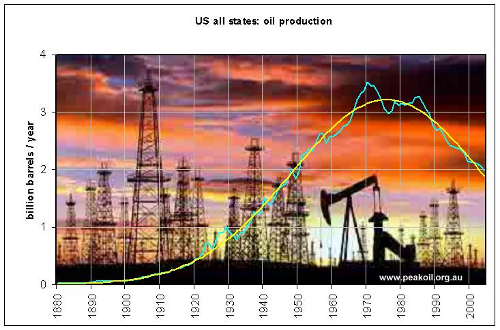
Peak oil commentators commonly cite the peak of oil production in the USA as an example for what the world faces as a whole in terms of oil production. The US peak appears quite symmetrical - the rate of production increase on the way up to the peak is broadly similar to the rate of production decrease after the 1970 peak of production.
Graph
However, the only reason why this could occur, in the face of decreasing EROI was because the USA was able to subsidise oil production post-peak using other forms of energy. The thousands upon thousands of pumpjacks  (“nodding donkey” oil pumps) that now extract the dregs of the USA’s oil inheritance are primarily powered by electricity from coal-fired and nuclear power plants. Despite its declining oil production, the USA’s population and economic activity have been able to expand since 1970 by using a larger amount of oil energy now provided by imported oil.
Today, the USA imports about two thirds of the oil energy it consumes. But after the world peak of oil production there will be no other place to import oil from. The process of oil extraction can be subsidised by coal, gas or nuclear-derived energy where access to these exists. However, the history of oil production has been a continuous journey to ever more remote and inaccessible areas to find oil. Unlike the USA, most of these areas do not have electricity “on tap”. Dmitry Orlov wrote very amusingly about the decline of oil production after the world peak in his essay, “The Slope of Dysfunction”.
To cover the costs of developing new sources of oil, the barrel price of oil must remain above US$70. However, as supply falls and economies continue to attempt to grow, oil will re-enter the economy-killing zone above $100 (where 5 per cent of world GDP is going to oil purchases. This will, once again, destroy economic activity leading to another reduction in oil demand and another collapse in the oil price to below the necessary US$70 per barrel. These gyrations in the oil price will discourage investment in new projects and contribute to a much faster drop in oil production. The happy news for motorists is that oil is unlikely ever again to reach $147/barrel (inflation adjusted). The unhappy news is that the motorists will probably be unemployed and unable to afford the oil in any case.
If our society and civilisation is to survive the challenge of declining oil (and, ultimately, declining natural gas, coal and uranium) we need to invest in renewable forms of energy and adapt to the more or less variable supply that the various renewable sources provide. (Improved battery technologies would be a huge assistance in this regard.)
However, renewables form only a tiny fraction of the world economy at present and expanding them to fill the fossil gap - while the economy is in decline, food production is disrupted and many other calls are being made on the dwindling net energy supply, will involve extreme sacrifice that the citizens of developed nations will only make unwillingly. By the time they realise the necessity there will probably be little net energy left to build the renewables infrastructure in any case.

Oil Prices 'Doing Significant Damage' To U.S. Economy, Moody's Says

Oil Prices 'Doing Significant Damage' To U.S. Economy, Moody's Says

Oil Prices
PAUL WISEMAN   04/ 6/11 06:50 AM ET   AP
WASHINGTON — Just when companies have finally stepped up hiring, rising oil prices are threatening to halt the U.S. economy's gains. Some economists are scaling back their estimates for growth this year, in part because flat wages have left households struggling to pay higher gasoline prices. Oil has topped $108 a barrel, the highest price since 2008. Regular unleaded gasoline now goes for an average $3.69 a gallon, according to AAA's daily fuel gauge survey, up 86 cents from a year ago. The higher costs have been driven by unrest in Libya and other oil-producing Middle East countries, along with rising energy demand from a strengthening U.S. economy. Airlines, shipping companies and other U.S. businesses have been squeezed. The rising prices are further straining an economy struggling with high unemployment and a depressed housing market. "The surge in oil prices since the end of last year is already doing significant damage to the economy," says Mark Zandi, chief economist at Moody's Analytics. Unlike other kinds of consumer spending, gasoline purchases provide less benefit for the U.S. economy. About half the revenue flows to oil exporting countries like Saudi Arabia and Canada, though U.S. oil companies and gasoline retailers also benefit. For consumers, more expensive energy siphons away money that would otherwise be used for household purchases, from cars and furniture to clothing and vacations. High energy prices are "putting a drain on consumer budgets," says James Hamilton at the University of California, San Diego. "To the extent they're having to spend more on gasoline, they have to make cutbacks elsewhere."
Two-thirds of Americans say they expect rising gasoline prices to cause hardship for them or their families in the next six months, according to a new Associated Press-GfK Poll. The telephone poll conducted March 24-28 had a sampling error margin of plus or minus 4.2 percentage points.
Seventy-one percent say they're cutting back on other expenses to make up for higher pump prices. Sixty-four percent say they're driving less. And 53 percent say they're changing vacation plans to stay closer to home.
"I try to leave the car parked at home all day Saturday," says Curt Lindsay, who commutes an hour each way to his job as a computer systems administrator outside Washington, D.C. "I'd rather not spend the money on gasoline."
Since gasoline prices topped $3 a gallon, Lindsay has also been trying to drive more slowly to conserve fuel.
His co-worker Albert Zaza canceled family trips to New York and Boston after the cost of filling up his Honda CRV surged from $35 to $47. Zaza spends four to five hours in traffic each day and has to fill up every other day.
Rising fuel prices are pinching businesses too.
In Tipton, Iowa, Grasshopper Lawn Care is tacking 5 percent onto customers' bills to compensate for higher fuel costs. The company has to buy more than 8,000 gallons of gasoline a year. It plans to keep the surcharge until gasoline prices dip back below $3 a gallon, owner Dan Kessler says.
The oil shock and global instability are diluting the benefits of an improving job market. The unemployment rate, though still high, is at a two-year low. And the economy has just produced the strongest two months of hiring since before the recession began.
Bernard Baumohl, chief economist at the Economic Outlook Group, has slashed his estimate for growth this year to 2.8 percent from 3.5 percent. In 20010, the economy grew 2.9 percent.
Consumer spending accounts for about 70 percent of the economy. After adjusting for inflation and for seasonal factors, consumers spent 0.3 percent more in February than in January.
But that's unlikely to last. Gasoline prices are surging just as inflation-adjusted incomes are falling. More expensive gas is draining much of the cash Americans are receiving from a cut in Social Security taxes this year.
Zandi estimates that higher oil prices shaved 0.5 percentage point from growth in the January-March quarter. He predicts the economy grew 2.6 percent during the quarter.
If oil prices average $100 a barrel for the year, Zandi says, growth will be 0.3 percentage point lower than if prices had stayed at last year's level – an average of less than $80 a barrel. A few months of $125-a-barrel oil would slash economic growth by a full percentage point, Zandi says. And a few months at $150 a barrel could push the economy back into recession.
Surging oil prices don't hurt everybody in the United States. Oil companies, for example, stand to gain. In 2008, Exxon Mobil Corp. earned $45 billion – a record for a U.S. company – after oil prices hit a record $150 a barrel.
Oil services companies such as Halliburton Co., Schlumberger Ltd. and Baker Hughes Inc. also benefit as the oil industry rushes to find and produce more oil. And the products of biodiesel and other alternative energy companies become more competitive the higher oil prices go.
In a speech last week, Sandra Pianalto, president of the Federal Reserve Bank of Cleveland, offered hope that higher oil prices won't persist long enough to do much damage.
"Large increases in food or energy prices tend to be temporary," Pianalto said. "History shows that they are often followed by sharp declines."
But Mark Pawlak, a market strategist at Keefe, Bruyette & Woods, says he worries about a repeat of what happened to the economy last year: It built momentum at the start of 2010, only to stall in the face of a European debt crisis and a run-up in oil prices from February to April.